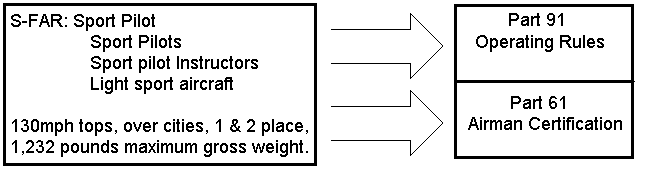
Now proposed by FAA:
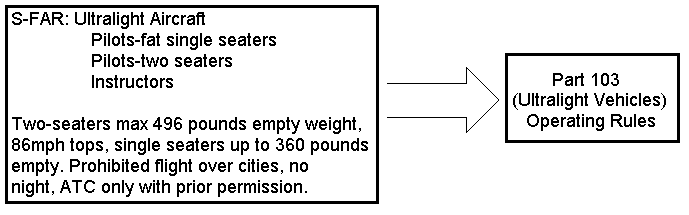
I recommend that a second-level be added:
April 27, 2002
Docket Management SystemRe: Certification of Aircraft and Airmen for the Operation of Light-Sport Aircraft; Proposed Rule
Docket No. FAA-2001-11133; Notice no. 02-03
Commentor’s background
I have been involved in aviation all of my life of 56 years. My father and mother flew and we always had a family plane. I first soloed an airplane (Cessna 140) when 16 years old in 1962.
I began hang gliding in 1977 and shortly thereafter became part owner of the dominant hang glider training school in southern California. For 3 years I taught ground school and primary flight training, and managed the facility at Playa del Rey, California.
Circa 1979 the United States Hang Gliding Association (USHGA) formed a Powered Hang Glider Division for which I became a ground and flight instructor. Also for USHGA, John Lake and I conducted USHGA Powered Hang Glider Instructor seminars (ICP). In 1979 I was president of the Southland Hang Gliding Club which was the forerunner of the United States Hang Gliding Association.
In 1980 I founded, owned and operated UltraSport, Inc., the first full service flight training and retail center for powered ultralight aviation in the Los Angeles area. I authored flight instructing programs and techniques including a tethered flight simulator that were publicized throughout the aviation industry. During this time I became one of the first FAA Safety Counselors for powered ultralights.
Based on my experience and industry notoriety, the Experimental Aircraft Association invited me to be the founding president of their Ultralight Division circa 1982-1984. I served in that volunteer role until shortly before EAA closed the division in 1984.
At AOPA Air Safety Foundation I wrote the original FAA recognized ultralight pilot/instructor training program from which all others have been derived. This was shortly after the issuance of FAR Part 103 (Ultralight Vehicles). There was close cooperation with FAA Flight Standards and FAA Accident Analysis.
I am the founder and past president of the United States Ultralight Association, Inc., the largest association devoted entirely to ultralight aviation in the world. On behalf of USUA I have written many petitions and exemption requests to FAA and developed member support programs of all kinds.
I have served on the Board of Directors for the National Aeronautic Association for over 10 years.
USUA’s highest honor, the John Moody Award for outstanding contribution to ultralight aviation, was awarded to me in 1995.
I am privileged to have received in 1999 the highest international microlight award, the Colibri Diploma as "the pre-eminent leader for ultralight and microlight aviation in the United States for 27 years." Only three other individuals have ever received a Colibri Diploma, and I am the only American.
My certificates include FAA commercial pilot and instructor—glider and private privileges for airplane (ASEL) with an instrument rating, USHGA Master hang glider pilot/instructor, aero-towing exemption holder, and seminar presenter, AOPA Air Safety Foundation ultralight pilot, instructor, seminar presenter and USUA Ultralight Flight Instructor #1 and seminar presenter.
I am the only individual to have received an FAA Commercial and Flight Instructor certificate by flying a trike (weight-shift control).
I am the only individual who participated in every ARAC meeting from which Sport Pilot (NPRM 11133) has come. (Even the primary FAA representative missed a couple.)
Finally, I care deeply about ultralight-type aviation, hang gliding and soaring, and hope to not only influence FAA but to influence others, too. Please consider my comments and agree in writing to FAA on those points you find valid—especially the two-level approach. It will take many comments to sway FAA to draw the ultralight exemptions into a second Special FAR, so I invite you join with me.
FAA has made numerous attempts to resolve regulatory problems associated with their inability to keep up with the growing interest in air sports aviation in general, and ultralight aviation in particular. I have observed and participated in the development of these regulatory attempts by FAA including Ultralight Vehicles, Recreational Pilot, Primary Category Aircraft, Sport Plane and now Light Sport Aircraft/Sport Pilot. In the past 15 years FAA organized research groups (paid by public funds) including a major regulatory review by Booze Allen Hamilton in 1988-1989 and the Aviation Rulemaking Advisory Committee (ARAC) Ultralight Working Group from 1993-1999.
In every case so far FAA has repeatedly (and admittedly) missed the regulatory need. This is simply because they do not comprehend the nature of the aviation segment they are trying to regulate. Over the past 30 years the convenience of jet powered commercial aircraft, combined with a vastly improved roadway system for modern automobiles, has gradually eroded the perceived utility of the four-place family airplane.
At the same time the evolutionary trend has gradually increased the relative value of aviation sports where participants choose craft that often appear unconventional but fly well and are too slow to be used for reliable transportation. They are for fun flying. They cost no more than their motorized counterparts in water and land sports. Flying, especially at slow speeds and in open cockpits, is tremendously rewarding. It is like you are flying. This trend is not a reinvention of airplanes so much as an expansion of recreation. It is intensely personal.
When allowed to let go of an unspoken need to regulate aviation as a transportation utility, the practical side of the regulatory approach changes. Risk management is different for pilots slow speed and low inertia aircraft. Danger tends to develop more slowly allowing the pilot to take corrective action based on a thought process more than relying on checklists. Therefore ultralight pilot training programs weight the decision-making process more than the emergency checklist type of approach required when flying relatively fast, heavy aircraft.
| NPRM 11133 says in part, "**There is uncertainty as to what extent the NTSB's database has fully captured those accidents involving unregistered light-sport aircraft over the past 10 years... There is uncertainty as to what extent these exemption holders' databases have fully captured those accidents for unregistered light-sport aircraft over the past 10 years... Because the accident databases listed above may not capture all relevant accidents, the potential safety benefits estimate for light-sport aircraft may be understated." |
The existing regulatory system does not provide for a reasonable path of entry and progressive development for ultralight/microlight pilots and instructors. The result is safety problems that are hidden from statistical analysis because FAA and NTSB ignore most microlight accidents (i.e. experimental-aircraft-with-ultralight-operating-characteristics). This is a serious matter. Some individuals have unnecessarily died because the reporting systems have failed to reveal common causes of accidents from which others could learn and improved regulatory programs created. It also prevents a reasonable business environment on which to base an industry. The cost of being unresponsive to this evolutionary trend is measured in wasted money and lives.
Yet, interest in microlight aviation is very strong in America and elsewhere around the world. In 1994, twenty-five countries reported to the international microlight commission more than 82,000 active pilots and 47,000 microlights that flew more than one million flight hours. One hundred eleven manufacturers reported a production total of 4,954 new planes just during that 12-month period. Each year the United States Ultralight Association, Inc. receives growing numbers of inquires by those who hope to fulfill life-long dreams of personal flight.
These numbers illustrate that many individuals worldwide are attracted to aviation sports for the deep fulfillment and personal accomplishment which fun flying offers.
FAA created a working group for "ultralights" on August 17, 1993. The purpose was to address the petitions of the USUA and generally to address the cadre of air sports aircraft and pilots that had developed during recent history. FAAs NPRM 11133 reports that it considered all, and incorporated some, of the ARAC committee recommendations.
But there is much more to the story.
After many meeting and long discussions, the Ultralight ARAC group met in December, 1995, and proudly voted to hand the draft NPRM to FAA. The agreement was not merely "consensus," but unanimous—no dissenters or withheld votes whatsoever. Interestingly, however, the proposal then was very different.
It recommended to FAA:
What happened when ARAC unanimously (and very proudly) agreed to hand the finished recommendations NPRM to FAA just before Christmas in 1995?
Silence.
After some weeks had passed there came reports of FAA holding private meetings with notable individuals from general aviation, and the Experimental Aircraft Association in particular. After a full year of stalling, FAA began to call another set of ARAC meetings.
By then most of the sporting groups had lost faith in the sincerity of FAA and the meetings became dominated with associations such as EAA, Aero Sports Connection, Capella and the Small Aircraft Manufacturers Association. They gained a majority of voting power and created a new recommendation with much higher weight, speed and pilot privileges. Sometime between the end of the ARAC meetings and the release of Sport Pilot (NPRM 11133), FAA internally decided to again increase the weights for some reason.
Only that second, final recommendation is reported by FAA. FAA says, "The ARAC working group submitted its recommendations to FAA for review in July, 1998. Much of FAA’s proposal is based on ARAC’s sport pilot certification recommendation..." The FAA did not adopt even one portion of the original, unanimous ARAC recommendations. But they were valid recommendations and should not be lost just because they weren’t what FAA wanted to hear.
FAA writes, "The ARAC recommended FAA include detailed privileges and limits in part 61…" This is incorrect. The ARAC group first recommended a new regulation (FAR). FAA made it clear that that was not an option, so the ARAC group reluctantly compromised by saying that FAA could place it as they wished so long as the tone, feel and intention was met. FAA immediately responded that Parts 61 and 91 would be the location, and now reports to the public that it was an ARAC recommendation.
Additionally, the international microlight community has provided (1994) written encouragement for FAA to adopt international microlight aircraft parameters which were exactly included in the first ARAC recommendation.
FAA has completely ignored this recommendation by the principal international representative group and instead refers to a few individual countries that have the expanded definitions that apparently better suits FAA intention. The increases from 992 pounds maximum to 1232; and especially the increase from 35 knot stall to 44 knot stall, is significant and in my experience has a profound effect on aircraft airworthiness and pilot training requirements. FAA simply states that, "[International harmonization]…is based on the premise that the number of the requirements contained in the proposal (namely, aircraft certification standards) essentially mirrors those that already exist internationally." This is insufficient justification to my mind.
Ultralight aviation is a cultural matter as well as technical specialty. Those who fly for fun have different regulatory needs than those intending to fly traditional aircraft for personal transportation in the airways and over cities. This cultural issue may again be being submerged under the push for a reduced medical and cheaper aircraft for existing pilots, the apparent thrust of Sport Pilot (NPRM 11133).
I enjoy knowing many of them and like the debating event that often occurs when I am in their Washington DC offices. FAA headquarters is less than 50 miles from my home, so I visit FAA whenever it seems advantageous.
However, not one single FAA employee within flight standards headquarters has personally flown ultralights on a regular basis for recreation. Flight standards is where pilot and instructor programs are created. The vacuum of actual, personal involvement in ultralight air sports has meant that hearsay and preconceived notions have become the basis for regulatory "improvement" at FAA headquarters. FAA focus on transportation is eclipsing an accurate view of air sports aviation. Because they do not understand this aviation group, their regulatory approaches have not worked well.
The primary FAA representative to the Sport Pilot ARAC meetings retired shortly after the meetings stopped. The very nice and capable person who is the new Sport Pilot coordinator and spokesperson never actually attended any sport pilot ARAC working group meeting. In fact no FAA employed now involved has first hand knowledge of the political and cultural issues that were discussed for so many hours.
It is better when the regulators participate in the community to be regulated. Surely the airlines would not stand for a regulatory department of individuals who had no commercial aviation experience. What if a town council in Iowa regulated a town in Oregon? I don’t think so. No FAA employees in Flight Standards have yet been ultralighters, and none have regularly personally attended the ARAC meetings. I believe this reduces the quality of rule proposals such as NPRM 11133, and makes comments from the aviation community more important.
I agree with USUA which believes both things should take place, both methods through 2 special regulations (S-FARS)—one S-FAR as now proposed and a second S-FAR associated with ultralight regulation to support the fat and two-place ultralights as proposed originally by ARAC when it was composed of more air sports groups.
Overall, the existing FAA proposal would be helpful to existing FAA licensed pilots and instructors. Some want to increase their flight privileges to include faster aircraft and overflight of cities. The proposed rule could provide that. I also believe the definition of the aircraft which a sport pilot could fly should be increased enough to include aircraft such as Cessna 150, 152, Piper Tomahawk, and other common 2-place general aviation aircraft. Finally, FAA might be wise to simply incorporate these changes into Recreational Pilot as FAA so strongly lobbied for during many ARAC meetings. The trick for FAA will be to adopt programs with these broad pilot privileges that end up being significantly "less" than the long-standing private pilot certificate (the downfall of Recreational Pilot).
Of special significance and commendation are the proposed new categories of aircraft for powered parachutes and trikes (weight-shift to FAA). This is very important as it would allow full private piloting privileges and would not limit powered parachutes and trikes to only 2 seats. If, as I fear might be the case, the sport pilot certificate gets too close to the private certificate, applicants could select to go directly to private while being trained entirely in powered parachutes or trikes as they choose. This may end up being the most successful part of the entire proposal related to pilot and instructor certification.
Many with whom I have spoken only want reasonable regulatory avenue to fly "fat" single and two-place ultralights for recreation. USUA and other groups have repeatedly petitioned FAA about this. FAA’s proposed requirement for every pilot and instructor of fat single seaters and two-place ultralight trainers go back into training for 130 mph aircraft is simply overkill. Each pilot would have to pass a comprehensive written test on general aviation rules (parts 61 & 91), an oral examination and flight test using some notoriously difficult to fly aircraft which could have top speeds over 130 mph and fly over our cities and towns. Existing ultralight operations demonstrate that many individuals prefer to give up such transportation-oriented speeds and over-city flights in trade for more recreationally oriented training programs such as now in use by several ultralight associations.
What I believe FAA should do is to create a two-tiered approach: sport pilot as proposed, and a second tier to address fat single and two-place ultralights. This mirrors the original ARAC recommendation for a separate FAR. Just as FAA proposes to attach a special federal regulation (S-FAR) named Sport Pilot to existing regulations of parts 61 & 91, I recommend that FAA attach a second S-FAR, named Ultralight Aircraft, to part 103 (Ultralight Vehicles).
Here is where the original, unanimous, ARAC recommendation can again be utilized. Bring into the second level tier the two-place training programs, recreational use of two-seaters, and a modestly increased definition for single seaters (H. O. Scale) as has been discussed and requested for decades by USUA, the international microlight commission, other air sports organizations and contained within the sport pilot ARAC’s first recommendation.
FAA mistakenly reports that, "… in 1995 when it issued the first exemption from part 103 for training." [Emphasis is mine] This is a very inaccurate and seriously misleading statement by FAA.
FAA actually began issuing exemptions allowing two-seat ultralights for training in 1983, only 9 months after issuing ultralight regulation (part 103) in October 1982. FAA has repeatedly renewed these exemptions to 4 or 5 various organizations every two years thereafter for almost 2 decades.
Interestingly, FAA also states, "Although we [FAA] issued exemptions to temporarily resolve the training issues, to extend them on a long-term basis would be an inappropriate use of the exemption process [emphasis is mine]. ‘The FAA believes that a permanent and appropriate level of regulation is necessary."
I don’t know how many years FAA has to continuously issue an exemption before it is considered "inappropriate use of the exemption process." But nineteen consecutive years of uninterrupted exemption renewals for multiple associations surely demonstrates the importance and significance to both FAA and the ultralight community for the need for two-place "ultralights." It also illustrates that the ultralight community has, in fact, operated two-seaters although the actual ultralight rule limits ultralights to only one seat.
In practice FAA has (sensibly) allowed two-seaters since the beginning. It is important to keep open the option for the training programs developed around two-seat ultralights. And through the years it has become clear that those who were trained in two-seat ultralights learned to fly two-seat ultralights.
The additional S-FAR should be similar to the S-FAR now proposed by FAA in that the Ultralight Aircraft S-FAR would provide FAA certificates for pilots and instructors, and "N" numbers for the aircraft. The written, oral and flight tests would be based on existing ultralight programs and enforced by FAA. Administration of the program might be, or might not be, through membership associations. The operating rules would come from part 103 including prohibition on flights over congested areas, not into ATC controlled airspace without prior permission, and no night flying—exactly as ultralight vehicles are presently limited.
This two-tiered approach encourages the FAA "Sport Pilot" to be finalized while permitting ultralighters to gain the authority for two-seat recreation use under the more restrictive ultralight regulation. This second option is critical for those who want to fly today’s ultralights and do not mind being relegated to rural areas.
I also recommend that FAR part 103 (Ultralight Vehicles) to be left unchanged.Sport pilot and instructor training programs are impossible to evaluate because they do not exist. FAA says that it will take from industry programs when establishing the standards (Pilot Testing Standards, PTS). But will FAA derive a program significantly different that private pilot? Only time will tell.
It is not possible to evaluate the contents of the airworthiness "consensus standards" for light sport aircraft as proposed by FAA until such standards exist. FAA words the NPRM to almost lead the reader to believe that the manufacturers will have say over the contents of the program, but FAA certainly has the last and final approval authority. How appropriate and reasonable will FAA be? We cannot know until we see a finished consensus standard. Therefore ultralight manufacturers, the FAA, and other affected parties should get together and create and publish the industry consensus standard before the public is obligated to respond to the NPRM without a full awareness of the ramifications of the light-sport aircraft certification process and costs.
Ultralight aviation has hosted vehicles with retractable land gear, variable pitch propellers, multi engines, and even an occasional pure-jet engine. FAA now proposes to make those combinations unavailable to sport pilots even though they will "be trained to a higher standard." Why should this be? I am aware of no evidence that these options have caused significant or wide-spread safety problems in single and two-seat ultralights.
Even model airplanes now have functional turbine engines. Some designers are talking of ultralight-type aircraft with multi engines (maybe 6, 8 or more engines) to minimize the dependence on any one engine. Retractable landing gear and variable pitch propellers are not complex devices only for those pilots with superior intelligence. Besides, some ultralighters have superior intelligence. The largest reported complexity with retractable landing gear is simply remembering to put it down before landing.
Let’s let those who are willing to accept additional training and receive an instructor’s log endorsement utilize these devices if they wish.
In addition to the groups addressed by FAA in NPRM 11133, I would like to specifically recommend that at least the Ultralight Vehicle SFAR include:
These activities have taken place under FAA exemption for many years and there is no basis in safety to terminate the activity of which I am aware. By issuing and reissuing exemptions for these purposes, FAA implies that aero-towing, two-place training and recreational flying in all forms of "ultralight" flying, including powered paragliding are important. This is correct. Also consider the fact that the tandem exemption for hang gliding includes the option of passenger flights for recreation. This has caused no problems.
These items should be perpetuated by inclusion in the Ultralight Vehicle SFAR as they are allowed by exemption today. To leave out these segments is to create a safety problem related to training because it will force single place training to be the only option. This is where the instructor (if there is one) stands on the ground and coaches (by hand signals or radio) the student’s first flights. Surely FAA does not deliberately intend to do this.
Pilot and instructor make/model-specific checkouts is unwarranted based on my considerable experience in providing transition training. Transition training is sometimes important, but it need not be federal law. The requirements within an Ultralight Aircraft (SFAR) instructor "aircraft" check out should be identical to what it is under the several training exemptions. Namely this is category/class checkout by a qualified instructor, but no make/model specific requirement. Again, accident data supporting an increase in existing requirements for the same aircraft is non-existent (remember the tier named Ultralight Vehicle SFAR is limited to only those two-place craft now known as ultralight trainers).
I appreciate the opportunity to make this personal comment for all to read. I hope it influences FAA. Too often my personal work in "industry and government" working groups has suffered from major compromise and political shenanigans. I love air sports aviation. What I recommend is from my deepest convictions and based on thousands of hours of flying and teaching.
John Ballantyne
[an error occurred while processing this directive]